
Reclaiming Control: Evidence-Based Strategies for Achieving Digital Wellness in an Always-On World
In the modern era, technology is the scaffolding of our daily lives. From the moment we wake to the moment we sleep, we are tethered to devices that inform, entertain, and connect us. However, this hyper-connectivity comes at a cost. The emerging concept of “Digital Obesity”, the overconsumption of digital data combined with a sedentary lifestyle is driving a spike in physical and mental health issues globally.
Achieving digital wellness does not mean rejecting technology; it means moving from a state of passive consumption to active, intentional usage. It requires re-engineering our habits to ensure that technology serves human biology, rather than eroding it.
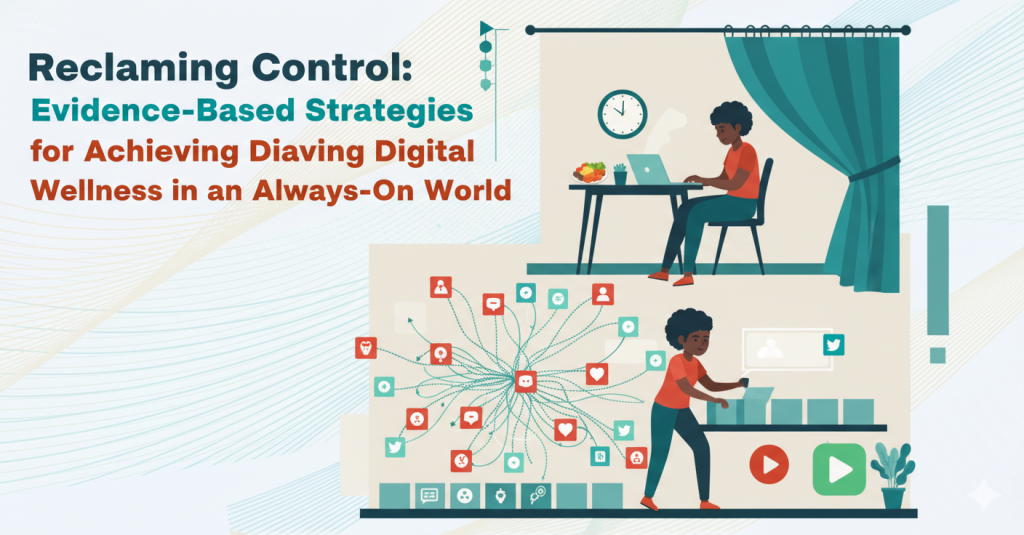
Below are five evidence-based strategies to achieve digital wellness, grounded in physiological and psychological research.
1. Combat Sedentary Digitalism with Micro-Breaks
The most significant physical risk of the digital age is the sedentary behavior associated with screen time. Prolonged sitting inhibits the production of lipoprotein lipase, an enzyme that breaks down fat, thereby increasing the risk of cardiovascular disease and type 2 diabetes (Hamilton et al., 2007).
The Strategy: Implement the Pomodoro Technique or a “Movement Micro-Break.”
-
How: Work for 25-50 minutes, then take a 5-minute standing or walking break.
-
Why: Even short bursts of activity can reset insulin levels and reduce the risk of “The Sitting Disease.” The World Health Organization (WHO) guidelines emphasize that replacing sedentary time with physical activity of any intensity provides health benefits (WHO, 2020).
2. Protect Your Circadian Rhythm: The Digital Sunset
Sleep is the foundation of mental health, yet it is the first casualty of the digital age. Screens emit blue light (short-wavelength enriched light), which suppresses the production of melatonin, the hormone responsible for regulating sleep-wake cycles.
The Strategy: Enforce a “Digital Sunset.”
-
How: Disconnect from all blue-light-emitting devices (phones, laptops, tablets) at least 60 minutes before bedtime.
-
Why: Research from Harvard Medical School indicates that blue light exposure at night shifts the circadian clock, leading to sleep deprivation, which is linked to depression, obesity, and cardiovascular disease (Harvard Health, 2020).
3. Mitigate Digital Eye Strain: The 20-20-20 Rule
“Computer Vision Syndrome” is affecting millions of workers and students, characterized by dry eyes, blurred vision, and headaches. Staring at a screen reduces our blink rate by up to 66%, causing strain.
The Strategy: Adopt the 20-20-20 Rule.
-
How: Every 20 minutes, look at something 20 feet away for at least 20 seconds.
-
Why: This simple exercise relaxes the ciliary muscles in the eye, reducing fatigue and preventing long-term myopia progression (American Optometric Association, 2023).
4. Practice Digital Nutrition: Curate Your Feed
Just as we watch what we eat, we must watch what we consume digitally. Social media platforms often trigger “Social Comparison Theory,” where users evaluate their own worth based on the curated “highlight reels” of others. This is a primary driver of anxiety and body dysmorphia among youth.
The Strategy: Curate your environment.
-
How: Audit your social media feeds. Unfollow or mute accounts that trigger feelings of inadequacy, anxiety, or anger. Follow educational, inspiring, or calming content instead.
-
Why: A study by the Royal Society for Public Health found that platforms like Instagram can have a net negative impact on well-being due to body image concerns and FOMO (Fear Of Missing Out) (RSPH, 2017).
5. Establish the Right to Disconnect
The blurring of work-life boundaries leads to chronic “Technostress”, the stress caused by the inability to cope with new computer technologies in a healthy manner. The pressure to respond to emails after hours keeps the body in a state of high alert (sympathetic nervous system activation), increasing cortisol levels.
The Strategy: Set rigid boundaries.
-
How: Turn off non-essential notifications after work hours. Use “Do Not Disturb” modes during deep work sessions.
-
Why: Psychological detachment from work during off-hours is crucial for recovery and preventing burnout (Sonnentag, 2012).
Conclusion
Digital wellness is not a luxury; it is a prerequisite for a sustainable future. By integrating these habits moving more, sleeping better, protecting our eyes, and curating our mental intake we can harness the power of the digital age without falling victim to it.
References
-
American Optometric Association. (2023). Computer Vision Syndrome (Digital Eye Strain). St. Louis, MO: AOA.
-
Hamilton, M. T., Hamilton, D. G., & Zderic, T. W. (2007). Role of low energy expenditure and sitting in obesity, metabolic syndrome, type 2 diabetes, and cardiovascular disease. Diabetes, 56(11), 2655-2667.
-
Harvard Health Publishing. (2020). Blue light has a dark side. Harvard Medical School.
-
Royal Society for Public Health (RSPH). (2017). #StatusOfMind: Social media and young people’s mental health and wellbeing. London: RSPH.
-
Sonnentag, S. (2012). Psychological Detachment From Work During Off-Job Time: The Role of Job Stressors, Job Involvement, and Recovery-Related Self-Efficacy. European Journal of Work and Organizational Psychology, 21(3), 325-342.
-
World Health Organization (WHO). (2020). WHO guidelines on physical activity and sedentary behaviour. Geneva: World Health Organization.
Author: The Secretariat, Coalition for Digital Education Wellness (CoDEW)
The Silent Crisis: Why Africa’s Digital Boom Must Not Become a Health Burden
Africa is currently navigating a digital renaissance. With the continent’s internet economy projected to reach $180 billion by 2025 (Google & IFC, 2020), digital transformation is rightly celebrated as a driver of education, financial inclusion, and economic growth. From the Silicon Savannah in Nairobi to the tech hubs of Lagos, connectivity is the new currency.
However, parallel to this trajectory of growth, a “silent crisis” is emerging. As our lives migrate online, the biological and psychological costs of hyper-connectivity are mounting. We are witnessing the rise of “Sedentary Digitalism”—a phenomenon where digital advancement correlates directly with physical inactivity and mental erosion.
This article argues that unless we re-engineer our digital ecosystems to prioritize human health, the economic gains of the Fourth Industrial Revolution will be offset by a crippling burden of Non-Communicable Diseases (NCDs) and mental health disorders.
The Physiology of Tech: The Rise of NCDs
The most immediate threat posed by the digital age is physical. The World Health Organization (WHO) identifies physical inactivity as the fourth leading risk factor for global mortality (WHO, 2022). In African urban centers, the shift from labor-intensive work to desk-bound, screen-based professions is accelerating this risk.
Research indicates a direct correlation between prolonged screen time and the rise of NCDs such as type 2 diabetes, cardiovascular disease, and obesity. A study published in The Lancet highlights that sedentary behavior, distinct from a lack of exercise, alters metabolic health, leading to insulin resistance and inflammation (Ekelund et al., 2016).
In the African context, this creates a “double burden” of disease. While healthcare systems struggle with infectious diseases, they are now overwhelmed by lifestyle diseases driven by what we term the “Sitting Disease.” The digital workplace, characterized by “Zoom fatigue” and endless virtual meetings, has effectively immobilized the workforce, turning the office chair into a significant health hazard.
The Psychology of the Algorithm: A Youth Crisis
Africa has the youngest population in the world, with 60% of the continent aged under 25. This demographic is the most digitally literate, but also the most psychologically vulnerable.
The business models of major social media platforms rely on the “Attention Economy”, designing algorithms to maximize user engagement through variable rewards (dopamine loops). For the developing brain, this constant connectivity can be detrimental.
Global data mirrors local realities: increasing screen time is linked to rising rates of anxiety, depression, and body dysmorphia among adolescents. The Shamiri Institute in Kenya has noted the growing need for mental health interventions in schools, where digital bullying and “social comparison” are rampant.
Furthermore, the phenomenon of “Algorithmic Anxiety”, the fear of being replaced by AI or the stress of keeping up with automated productivity standards—is creating a generation of young professionals who are burnt out before they even reach their prime.
The Economic Cost of “Always-On” Culture
The blurring of boundaries between work and home, facilitated by smartphones and high-speed internet, has birthed an “Always-On” culture. While this appears productive, evidence suggests otherwise.
Microsoft’s Work Trend Index found that digital overload is real and rising, with employees reporting higher levels of burnout and decreased innovation (Microsoft, 2021). When the brain is denied recovery time (the “Right to Disconnect”), cognitive function declines. For African economies striving for innovation, a burnt-out workforce is a liability, not an asset.
The Path Forward: Re-Engineering the Ecosystem
The solution is not to reject technology, but to humanize it. As we approach the 2nd Digital Education & Wellness Symposium (DEWS 2026) in Nairobi, the call to action is clear: we must treat Digital Wellness as a pillar of public health.
This requires a tripartite approach:
-
Policy: Governments must introduce “Digital Labor Rights,” including the Right to Disconnect, to protect workers from digital exploitation.
-
Corporate Responsibility: Tech companies and employers must adopt “Wellness by Design” principles, ensuring that software and workflows respect human biological limits.
-
Education: We must integrate “Digital Nutrition” into school curricula, teaching youth not just how to code, but how to consume content safely and critically.
Conclusion
Technology is a tool, not a master. If Africa is to realize its potential as a global digital powerhouse, it must build its smart cities on the foundation of healthy bodies and resilient minds. We cannot outsource our health to an algorithm. The time to re-engineer our digital future is now.
References
-
Ekelund, U., et al. (2016). Does physical activity attenuate, or even eliminate, the detrimental association of sitting time with mortality? A harmonised meta-analysis of data from more than 1 million men and women. The Lancet, 388(10051), 1302-1310.
-
Google & IFC. (2020). e-Conomy Africa 2020: Africa’s $180 Billion Internet Economy Future. International Finance Corporation.
-
Microsoft. (2021). The Next Great Disruption Is Hybrid Work—Are We Ready? 2021 Work Trend Index Annual Report. Microsoft Corporation.
-
World Health Organization (WHO). (2022). Global Status Report on Physical Activity 2022. Geneva: World Health Organization.
-
World Health Organization (WHO). (2018). Global Action Plan on Physical Activity 2018–2030: More Active People for a Healthier World. Geneva: World Health Organization.
Author: The Secretariat (Youth Initiative Development Programme & Triple I Foundation, Coalition for Digital Wellness (CoDEW)
The Gaps: Why Kenya Needs Digital Education Wellness Now More Than Ever
🖥️ 1. Telemedicine & Mental Health: A Lifeline in Crisis
- Kenya has only 116 psychiatrists for a population of over 50 million (MOH, 2023).
- Telemedicine has the potential to bridge this gap, but challenges like high data costs, lack of awareness, and digital literacy barriers prevent many from accessing these services.
- Youth are particularly vulnerable—suicide rates among Kenyan students have surged by 45% in the past five years (Mental Health Taskforce Report, 2023).
💡 Solution Focus:
- Strengthen telemedicine access through school-based mental health programs.
- Subsidize digital mental health services for low-income communities.
- DEWS2025 will host a panel on digital mental health strategies to push for policy integration.
🌱 2. Climate Action & Mental Health: The Hidden Crisis
- Over 5 million Kenyans were affected by floods and droughts in 2023 (NDMA Report, 2024), causing anxiety, depression, and eco-trauma, particularly among youth.
- Digital platforms can play a critical role in raising awareness and promoting climate resilience.
💡 Solution Focus:
- Introduce climate education in digital learning to equip youth with coping skills.
- Strengthen community-led digital platforms for climate action and mental health awareness.
- DEWS2025 will explore how digital innovations can build climate resilience while safeguarding mental well-being.
👶 3. Online Child Sexual Exploitation & Mental Health: Protecting the Next Generation
- A UNICEF report (2023) states that 2 in 5 Kenyan children have encountered online sexual exploitation.
- The rise of unsupervised internet access, gaming platforms, and social media has made it easier for predators to target children.
💡 Solution Focus:
- Implement AI-driven child protection tools in digital learning environments.
- Strengthen school-based digital safety programs.
- At DEWS2025, cybersecurity experts will present strategies to combat online child exploitation.
🚨 4. Online Trafficking & Mental Health: The Digital Dark Side
- Kenya is a hotspot for human trafficking, with digital platforms increasingly being used to recruit victims under the guise of online job opportunities.
- Survivors often experience severe PTSD, depression, and trauma, yet mental health support remains inadequate.
💡 Solution Focus:
- Strengthen digital labor market regulations to prevent online trafficking scams.
- Expand psychosocial support services for survivors through digital platforms.
- DEWS2025 will host a multi-sectoral discussion on digital safety, trafficking prevention, and mental health.
🚺 5. Online Gender-Based Violence (GBV) & Mental Health
- A 2023 study found that 74% of Kenyan women aged 18-35 have experienced some form of online harassment (UN Women, 2023).
- Cyberstalking, revenge pornography, and doxxing have led to increased anxiety, depression, and even suicide.
💡 Solution Focus:
- Strengthen gender-sensitive cybersecurity laws.
- Expand digital literacy and self-defense programs for women and girls.
- DEWS2025 will feature a women-led forum on tackling online GBV and mental wellness.
❤️ 6. Online Dating & Mental Health: The Rising Femicide Connection
- The increase in dating apps and social media interactions has coincided with a sharp rise in femicide cases in Kenya.
- Many young women are lured into abusive relationships or financial scams, leading to trauma, violence, and even death.
💡 Solution Focus:
- Stricter regulations on online dating platforms.
- Digital safety education for young people, particularly women.
- DEWS2025 will address online dating risks and propose solutions to protect users.