
Africa is currently navigating a digital renaissance. With the continent’s internet economy projected to reach $180 billion by 2025 (Google & IFC, 2020), digital transformation is rightly celebrated as a driver of education, financial inclusion, and economic growth. From the Silicon Savannah in Nairobi to the tech hubs of Lagos, connectivity is the new currency.
However, parallel to this trajectory of growth, a “silent crisis” is emerging. As our lives migrate online, the biological and psychological costs of hyper-connectivity are mounting. We are witnessing the rise of “Sedentary Digitalism”—a phenomenon where digital advancement correlates directly with physical inactivity and mental erosion.
This article argues that unless we re-engineer our digital ecosystems to prioritize human health, the economic gains of the Fourth Industrial Revolution will be offset by a crippling burden of Non-Communicable Diseases (NCDs) and mental health disorders.
The Physiology of Tech: The Rise of NCDs
The most immediate threat posed by the digital age is physical. The World Health Organization (WHO) identifies physical inactivity as the fourth leading risk factor for global mortality (WHO, 2022). In African urban centers, the shift from labor-intensive work to desk-bound, screen-based professions is accelerating this risk.
Research indicates a direct correlation between prolonged screen time and the rise of NCDs such as type 2 diabetes, cardiovascular disease, and obesity. A study published in The Lancet highlights that sedentary behavior, distinct from a lack of exercise, alters metabolic health, leading to insulin resistance and inflammation (Ekelund et al., 2016).
In the African context, this creates a “double burden” of disease. While healthcare systems struggle with infectious diseases, they are now overwhelmed by lifestyle diseases driven by what we term the “Sitting Disease.” The digital workplace, characterized by “Zoom fatigue” and endless virtual meetings, has effectively immobilized the workforce, turning the office chair into a significant health hazard.
The Psychology of the Algorithm: A Youth Crisis
Africa has the youngest population in the world, with 60% of the continent aged under 25. This demographic is the most digitally literate, but also the most psychologically vulnerable.
The business models of major social media platforms rely on the “Attention Economy”, designing algorithms to maximize user engagement through variable rewards (dopamine loops). For the developing brain, this constant connectivity can be detrimental.
Global data mirrors local realities: increasing screen time is linked to rising rates of anxiety, depression, and body dysmorphia among adolescents. The Shamiri Institute in Kenya has noted the growing need for mental health interventions in schools, where digital bullying and “social comparison” are rampant.
Furthermore, the phenomenon of “Algorithmic Anxiety”, the fear of being replaced by AI or the stress of keeping up with automated productivity standards—is creating a generation of young professionals who are burnt out before they even reach their prime.
The Economic Cost of “Always-On” Culture
The blurring of boundaries between work and home, facilitated by smartphones and high-speed internet, has birthed an “Always-On” culture. While this appears productive, evidence suggests otherwise.
Microsoft’s Work Trend Index found that digital overload is real and rising, with employees reporting higher levels of burnout and decreased innovation (Microsoft, 2021). When the brain is denied recovery time (the “Right to Disconnect”), cognitive function declines. For African economies striving for innovation, a burnt-out workforce is a liability, not an asset.
The Path Forward: Re-Engineering the Ecosystem
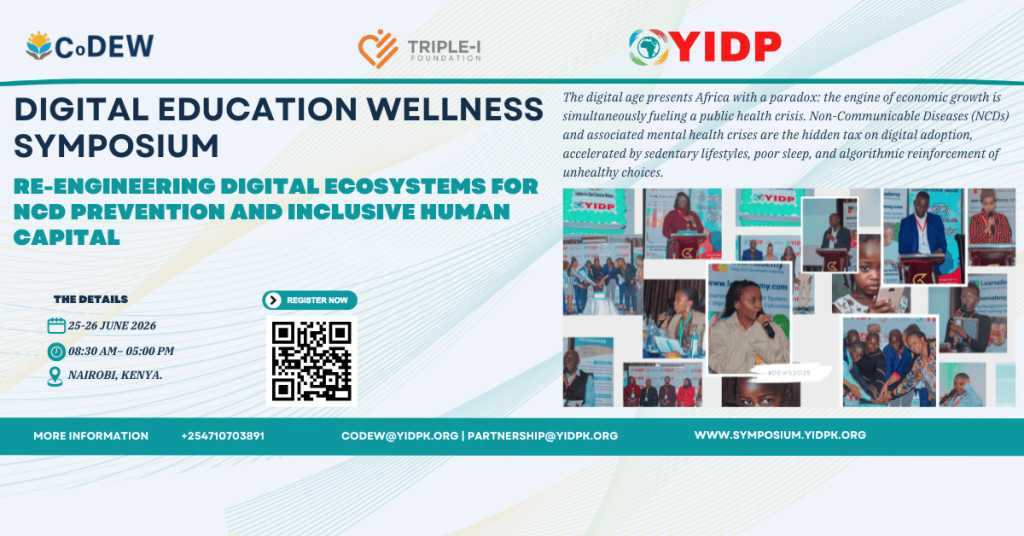
The solution is not to reject technology, but to humanize it. As we approach the 2nd Digital Education & Wellness Symposium (DEWS 2026) in Nairobi, the call to action is clear: we must treat Digital Wellness as a pillar of public health.
This requires a tripartite approach:
-
Policy: Governments must introduce “Digital Labor Rights,” including the Right to Disconnect, to protect workers from digital exploitation.
-
Corporate Responsibility: Tech companies and employers must adopt “Wellness by Design” principles, ensuring that software and workflows respect human biological limits.
-
Education: We must integrate “Digital Nutrition” into school curricula, teaching youth not just how to code, but how to consume content safely and critically.
Conclusion
Technology is a tool, not a master. If Africa is to realize its potential as a global digital powerhouse, it must build its smart cities on the foundation of healthy bodies and resilient minds. We cannot outsource our health to an algorithm. The time to re-engineer our digital future is now.
References
-
Ekelund, U., et al. (2016). Does physical activity attenuate, or even eliminate, the detrimental association of sitting time with mortality? A harmonised meta-analysis of data from more than 1 million men and women. The Lancet, 388(10051), 1302-1310.
-
Google & IFC. (2020). e-Conomy Africa 2020: Africa’s $180 Billion Internet Economy Future. International Finance Corporation.
-
Microsoft. (2021). The Next Great Disruption Is Hybrid Work—Are We Ready? 2021 Work Trend Index Annual Report. Microsoft Corporation.
-
World Health Organization (WHO). (2022). Global Status Report on Physical Activity 2022. Geneva: World Health Organization.
-
World Health Organization (WHO). (2018). Global Action Plan on Physical Activity 2018–2030: More Active People for a Healthier World. Geneva: World Health Organization.
Author: The Secretariat (Youth Initiative Development Programme & Triple I Foundation, Coalition for Digital Wellness (CoDEW)
Thanks for sharing